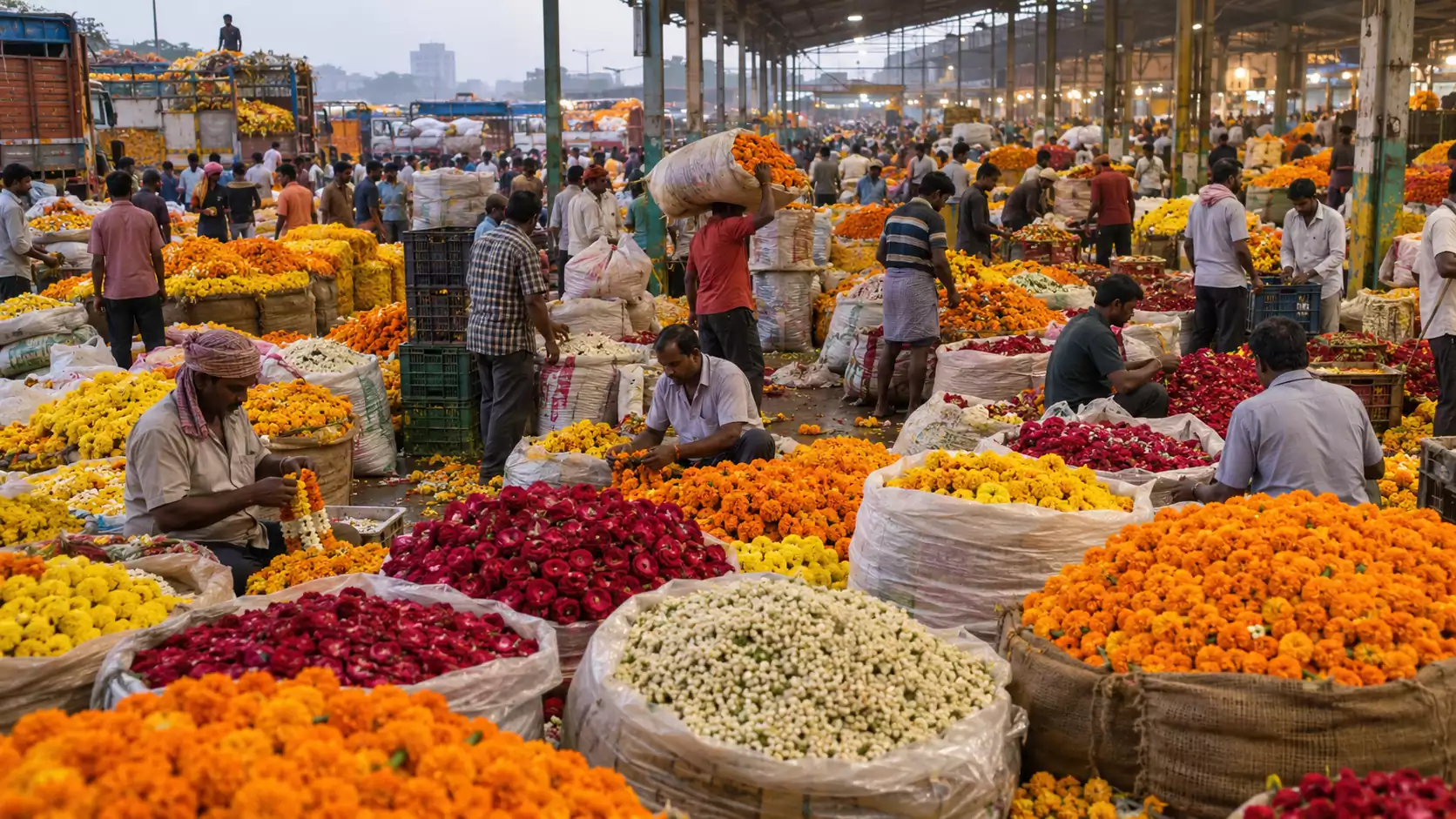
If you have ever tried to build a wedding flower budget from a price list you found online, you already know the problem: by the time you show the client a quote, the numbers are wrong. Bulk flower rates in India do not sit still. They shift with the harvest, with the weather, with a festival date, and with how many other decorators called the same supplier that morning. A static price list is a liability in this trade — not a planning tool.
This guide does not give you a price list. Instead, it gives you a budgeting framework that works regardless of where rates land on the day you are sourcing. Use it to structure your client conversations, build resilient quotes, and protect your margin when the market moves against you.
Why Bulk Flower Prices Move Every Day
Understanding the forces behind price movement is the first step to planning around them. Bulk flower rates in India are driven by several overlapping factors, none of which you control — but all of which you can anticipate.
Mandi Auction Dynamics
Most cut flowers in India pass through wholesale auction markets before they reach your hands. At a mandi, daily lot sizes, the number of active buyers, and the quality of that morning's arrivals all interact to set the day's rate. A small harvest in the producing region — Pune, the Nilgiris, or an importing farm — tightens supply and pushes the clearing price up. A surplus, even of a day or two, reverses it. There is no smoothing mechanism. The rate you see today reflects that morning's auction, not last week's.
Weather and Harvest Volume
Flowers are perishable agricultural products. An unseasonal heat spike shortens vase life and reduces the proportion of marketable stems from a given harvest. Heavy rain at the wrong point in the growing cycle delays flowering and compresses supply. Decorators working with a quarterly seasonal sourcing plan are far better positioned than those sourcing reactively, because they can anticipate which varieties are likely to be scarce and plan substitutions in advance.
Festival and Wedding-Date Demand Spikes
The Indian event calendar creates predictable demand cliffs. In the weeks surrounding Diwali, Dussehra, and the main wedding season windows, every decorator in the region is sourcing simultaneously. The arithmetic is straightforward: the same supply, more buyers, higher clearing prices. A date that sits between two large wedding clusters can see materially different rates than the week before or after. Mapping your client's event date against the regional wedding calendar before you quote is not optional — it is basic risk management.
Perishability and Cold-Chain Cost
Unlike most commodities, unsold flowers cannot be warehoused and released later. If a consignment does not clear the market, it is a loss. That perishability premium is baked into bulk rates, and it rises sharply during transport-intensive deliveries. Understanding how storage and cold-chain affect flower condition helps you negotiate intelligently: a supplier who holds the cold chain tightly can often hold a rate longer than one who cannot.
The Budget Framework: Ratios, Not Numbers
The most durable way to plan a wedding flower budget is to work in proportions of total floral spend rather than fixed amounts. This approach survives rate movement because the ratios stay roughly constant even when the absolute numbers shift.
"Build the budget as a percentage allocation across event zones, not as a line-item cost sheet. When the market moves, the proportions hold — only the base changes."
Typical Allocation by Zone
Across Indian wedding formats — whether a two-day celebration or a five-function event — floral spend tends to cluster around predictable zones. Use these as a starting framework, then adjust for the client's visual priorities:
- Mandap / main ceremony structure: The largest single share of floral spend. The mandap is the visual anchor of the ceremony and typically absorbs the greatest proportion of premium blooms. See our deep-dive on the best flowers for mandap decoration for variety-level guidance.
- Stage and backdrop: The second major zone. Backdrop coverage requires high stem density and consistent bloom size — both factors that affect rate significantly.
- Entrance and aisle: High visual impact relative to stem count if designed efficiently. Often the best zone for premium blooms because the quantities are smaller.
- Table centerpieces: Mid-weight zone. Scale depends on table count. A per-table stem target, calculated using a reliable wedding flower calculator, prevents over-ordering here.
- Garlands, varmala, and gifting: Often underestimated. Garlands can consume a significant share of roses and marigolds from the total order. Lock these quantities early.
- Wastage and breakage buffer: A separate allocation — typically a fixed percentage of total stem count — that accounts for transit damage, stem rejection on arrival, and setup losses. Skipping this buffer is the fastest route to a shortage on event day.
Once the client approves the allocation split, you can apply any market rate to the framework and the relative proportions hold. Adjust the total up or down based on the rate you get on sourcing day; adjust the mix across zones if one bloom category has spiked. The structure survives the movement.
The Peak-Season Multiplier
Wedding and festival season dates in India carry a cost premium that is well understood by every experienced supplier — but often not fully communicated to clients until the quote arrives. The gap between an off-peak sourcing rate and a peak-season rate for the same variety and volume can be substantial. The exact multiplier varies by region, variety, and year, which is precisely why you should never quote a client a fixed number based on off-season research.
What you can do is frame the risk correctly: tell the client early that their event date sits within a high-demand window, and that the only way to protect the budget is to lock the allocation ahead of time. An early booking with a confirmed stem count and agreed quality specification is the most effective cost-control tool available in this trade. It removes you from the spot market on a day when every other decorator is also there.
Our quarterly sourcing guide for India maps the major demand spikes by season so you can plan your client calendar accordingly.
Volume, Lead Time, and Consolidated Delivery
Order size and timing are the two levers you control directly — and both move the rate you are offered.
Volume: Larger consolidated orders allow suppliers to plan their procurement across farms and reduce their per-stem handling cost. That saving is typically passed back in the form of a better rate. Splitting one large event into multiple small orders from different suppliers eliminates this advantage.
Lead time: A supplier who has thirty days to source your stems can plan efficiently. A supplier who has three days is sourcing from whatever is available at the mandi that morning, at that morning's rate. Short lead times compress your negotiating position. Learning to estimate stem counts accurately well before an event is the operational skill that makes lead time an asset rather than a liability.
Consolidated delivery: Cold-chain logistics cost scales with the number of drops, not just the distance. A single consolidated delivery to one venue is more efficient than multiple partial deliveries. Building your order around a single delivery window — and ensuring your cold-storage capacity on-site matches — keeps logistics costs from eroding the rate advantage you negotiated.
Where Decorators Overspend
The most common budget overruns in Indian wedding floristry are not caused by high market rates — they are caused by structural habits that inflate the order regardless of what the market is doing.
- Over-ordering premium blooms for zones that don't require them. Not every surface needs a first-grade rose. Entrance pillars seen from ten metres away perform equally well with a well-selected seasonal alternative.
- Under-using filler. Filler flowers do structural work that premium blooms cannot replicate efficiently — they add volume, soften gaps, and hold the arrangement. Under-relying on filler means over-ordering focal blooms to compensate.
- Last-minute sourcing. Sourcing within seventy-two hours of an event means accepting spot-market rates and spot-market quality. The supply you can access is whatever was not taken by other buyers earlier in the week.
- Ignoring seasonality. A bloom that is abundant and high-quality in January may be scarce and poor-quality in May. Building a design concept around an out-of-season variety is a guaranteed cost overrun.
- No wastage buffer. Ordering to exactly the theoretical stem requirement with no allowance for transit damage or rejected stems is a plan that fails on arrival. A fixed buffer — calculated as a proportion of total stems — should be non-negotiable in every quote.
How to Build a Quote That Survives Price Movement
A quote that commits to a fixed total before you have sourced is a liability. A quote structured correctly protects both you and the client when the market moves.
Quote in Ranges, Not Fixed Totals
Present the client with a band rather than a single figure, clearly tied to the sourcing date and market conditions. Explain that the range reflects realistic rate movement for their event window, and that early confirmation narrows it by locking the allocation. This is not a weakness in your proposal — it is honesty about how the supply chain works, and experienced clients understand it.
Set Quote Validity Windows
Every quote should carry an explicit validity period. A quote valid for seven days disciplines the client decision timeline and protects you from market movement between the quote and the booking. After the validity window expires, the quote requires re-sourcing.
Lock Rates Ahead of Peak Season
For events in high-demand windows, a confirmed booking with a partial advance payment locks the supplier's allocation and the agreed rate. This is the only reliable mechanism to protect the budget from peak-season price movement. No other technique replaces it.
Build a Wastage Allowance Into Every Quote
The wastage buffer is not a contingency you hope not to use — it is a structural component of an accurate quote. It should be calculated as a percentage of total stem count and included transparently. Clients who understand the supply chain accept it readily.
Substitution Strategy: Protecting the Look When a Bloom Is Expensive
When a specific variety has spiked in price — whether due to a supply shortage, a festival surge, or a weather event — substitution is the practical response. The goal is to preserve the visual intent of the design while sourcing from what is abundant and well-priced that week.
Effective substitution requires knowing the design properties you are trying to replicate — scale, texture, colour temperature, and longevity — rather than being locked to a specific flower name. A large-headed cream carnation can carry a mandap drape that a white rose was originally specified for. A seasonal spray chrysanthemum can fill a backdrop with the same density as a focal bloom at a fraction of the stem cost. The full range of filler and secondary blooms available in India gives you a deep substitution library if you know their visual properties.
Build substitution options into every design proposal from the start: specify a primary bloom and a seasonal alternative. When the primary is well-priced, use it. When it is not, activate the alternative without renegotiating the design. This flexibility is a professional competency, not a compromise.
Get Today's Rate, Not a Stale List
Every principle in this guide depends on one thing: accurate, current rate information at the time you are building a quote. A rate from last month, a price list from a website, or a number you remember from a previous event is not a planning input — it is noise.
The only number that matters is the rate available today, for your specific stem count, quality grade, delivery date, and location. That number requires a conversation with a supplier who is actively in the market.
At Fleur Vine, we work directly with farm networks and provide current-rate quotes for bulk orders across India. Contact us for a current rate quote for your next event. Bring your stem count and event date, and we will give you an accurate number — not a list that was accurate three weeks ago.
← Back to all articles